
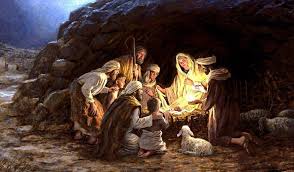
This sermon was preached on December 24, 2025, being the Eve of the Nativity of Our Lord Jesus Christ, at the 5:00pm Rite II Christmas Eve Mass at Saint Mark’s Episcopal Church (Lappans) in Boonsboro, Maryland and the 11:00pm Christmas Eve Mass at the Chapel of Saint James of Jerusalem at Saint James School in Hagerstown, Maryland.
Readings: Isaiah 9.2-7; Psalm 96; Titus 2.11-14; Luke 2.1-20
Collect of the Day: “Almighty God, you have given your only-begotten Son to take our nature upon him, and to be born [this day] of a pure virgin: Grant that we, who have been born again and made your children by adoption and grace, may daily be renewed by your Holy Spirit; through our Lord Jesus Christ, to whom with you and the same Spirit be honor and glory, now and for ever. Amen.”
“They made known the saying which had been told them concerning this Child; and all who heard it wondered at what the shepherds told them…Mary kept all these things, pondering them in her heart.”—Luke 2.17-19
In the Name of God the Father, God the Son, and God the Holy Ghost. Amen.
Fourteen years ago, I was preparing to acolyte the Christmas Eve Mass at Saint Thomas Church Fifth Avenue in midtown Manhattan. During my preparations, I noticed something I had never seen done and which struck me as odd. I saw the Paschal Candle, normally displayed throughout Easter, placed right behind the Christmas Crèche. I asked the then rector—and my mentor—why was this Eastertide symbol being put out on Christmas Eve. He, the constantly- evangelizing catechist, told me, “Brandt, Christ was born to die. There can’t be Easter without Christmas and Christmas is the start of the journey toward Easter.” The sight of the Christmas Crèche and Paschal Candle became a reminder that the Incarnation was the start of God’s plan for His Son’s death and resurrection to be the means for humanity’s salvation. It conveyed just how much Christmas and Easter are inseparably linked in God’s redemptive mission.[1]
That is why we should rejoice even more this night. Our Savior, Jesus Christ, has been born to die and be raised for us. That God, in the Person of Jesus, would voluntarily come into our time, put on human flesh, and suffer to open unto us the way of salvation amazes me. I see in Jesus the worth of recommitting my life to Him, renouncing all temporal passions and living a sober, righteous, and godly life in this world. This is for us all a most holy night, “for the grace of God has appeared for the salvation of all men.[2]
Luke notes Jesus’ birth as having occurred during the reign of Caesar Augustus, founder and first emperor of the Roman Empire. His reign started the Pax Romana, a 200-year period of relative peace from war, prosperous stability, and imperial expansion. The ancient Roman poet Virgil regarded Augustus as all the world’s savior and peacemaker, believing he was fulfilling a divinely ordered destiny. It was believed that Augustus would create an endless empire.[3]
Yet, it is Jesus’ birth we celebrate, not Caesar’s. It is God’s Kingdom, personified in our Incarnate King, that is endless and eternal, not the Roman Empire. That is because Jesus Christ our King has come in humility, being born poor and placed in a manger, not in a grand palace. His Kingdom has spread through the doing of justice, kindness, and righteousness, not through political maneuvers or military conquests. The true King of Peace born this night has come to us “not to be served but to serve, and to give His life as a ransom for many.”[4] He has, for a time, come down from Heaven to bring us back up with Him to Heaven, to live with Him in His Kingdom that is eternal and joyous, free from every misery and sorrow. The contrasts Luke thus presents us are clear. Augustus’s peace and empire are temporary; Jesus’ peace and Kingdom are eternal. To whose kingdom and authority will you this night surrender?
That is a question worth seriously pondering. We should regard the example of blessed Mary, Our Lady, who Luke says “kept all these things, pondering them in her heart.” Unlike Martha in Luke 10, our Blessed Lady Mary is not at this moment “distracted with much serving” or “anxious and troubled about many things.”[5] She takes intentional time to ponder over everything that has happened and been said about her Holy Child, treasuring all of it in her heart. The message of the angel is a treasured word. The shepherds’ adoration of our newborn King is a treasured act to witness. We should devote intentional time to ponder, to treasure the miraculous acts of God done this night. What do all the words and every action mean for us not just now and tomorrow, but in the weeks, months, years, for the rest of our lives to come?
For Mary and Joseph, challenging complications seemed to be up against them. Mary would encounter judgment for becoming pregnant before officially living with Joseph; Joseph most likely experienced judgment for staying with Mary despite the circumstances. Like them, there will be people who will unfairly judge us, who will not understand, and will not try to understand. We (might) have or some of us might now be experiencing problems with family members, jobs, certain friends/acquaintances, or financial issues. Our question tonight amid such hardships is like Mary’s from the Annunciation, “How will this be?”[6] You may be thinking to yourself, “I am not strong enough. I do not have enough money. I do not think I can carry on.” Remember the prophet’s words: “For to us a Child is born, to us a Son is given…and His Name [shall] be called ‘Wonderful Counselor, Mighty God, Everlasting Father, Prince of Peace.’”[7] This most Holy Child now come to us empowers us to continue living our lives in hope, trusting in good and righteousness, loving as He first loved us, walking with confidence, and facing each obstacle that appears insurmountable. Rejoice! Emmanuel, “God with us,” has come down and is with us.
We therefore this night have a choice to make. Mary said yes to bearing Christ into the world: “Let it be to me according to God’s Word.” Joseph said yes to standing beside Mary and help raise the Christ Child, doing as the angel commanded him. Because of their belief in God’s Word and trust in His presence, Mary and Joseph were able to overcome all societal judgments made against them. The same can be for us. Will we, like Mary and Joseph, trust in God and chose His will for us over our own? Will we, like the shepherds, not just hear the angel’s words but actually “go over…and see this thing that has happened, which the Lord has made known to us”? If we have the courage to trust what we have heard and seen from this most Holy Child through the faith and courage of others who have trusted Him in all the years, then we will see in Him our lives’ worth, which is everything to Him. Christ has come down to us as a newborn Child this night because you mean so, so much to Him.
Like the shepherds, may we all this holy night glorify and praise God for all the things we have heard and seen, as it has been told us. Most importantly, like Mary, our Blessed Lady, let us keep all these things, pondering them in our hearts, not just this night, but until we come face-to-face with the risen Jesus in His most glorious and eternal Kingdom.
My dear friends, a very merry Christmas to you all.
In the Name of God the Father, God the Son, and God the Holy Ghost. Amen.
[1] Cf. John 10.10; Romans 6.5-11.
[2] Titus 2.11-12.
[3] Robert Fitzgerald’s 1983 translation of The Aeneid is said to be the best translation of Virgil’s epic.
[4] Matthew 20.28; cf. Philippians 2.5-8.
[5] Cf. Luke 1o.38-42.
[6] Luke 1.34.
[7] Isaiah 9.6.

 THE ANGLO-CATHOLIC GENTLEMAN
Leave a comment